


1 oz 2026 150th Anniversary of the Library of Parliament Colourized Proof Silver Coin | Royal Canadian Mint
Related products
A UHR celebration of 150 years of architectural splendour and civic purpose.
Rising up from Parliament Hill in our nation’s capital—and from this coin’s surface, thanks to Ultra High Relief (UHR)—the Library of Parliament has stood as a beacon of democracy and learning since 1876. Its iconic dome and ornate stonework withstood the devastating fire of 1916, enduring as the sole surviving piece of the original Centre Block building. Today, beneath the gaze of the iconic Peace Tower, the Library stands as an architectural marvel that continues to inspire Canadians on its 150th anniversary; it is a living testament to our shared pursuit of knowledge, democratic values, and cultural memory.
Bound by history: Canada’s Library of Parliament at 150.
COIN HIGHLIGHTS
- Proudly standing since 1876. Celebrate a century and a half of knowledge, heritage and inspiration—celebrate the 150th anniversary of Canada’s Library of Parliament!
- Repository of parliamentary history. With this design, the RCM is honouring the Library of Parliament’s historic milestone by celebrating both its structure and its story as a vital resource for parliamentarians and the public.
- A limited collectible. Crafted in 1 oz. of 99.99% pure silver with a mintage of 4,500 coins available worldwide.
- Includes serialized certificate. The Royal Canadian Mint certifies all of its collector coins.
- No GST/HST.
PACKAGING
Your coin is encapsulated and presented in a Royal Canadian Mint-branded clamshell with a black beauty box.
ENGRAVED IN ULTRA HIGH RELIEF (UHR)
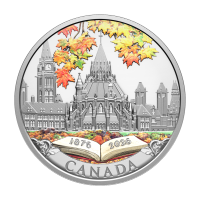
In this rear view of the Centre Block building on Parliament Hill in Ottawa, Ultra High Relief (UHR) emphasizes the Library of Parliament’s octagonal building by raising it higher than the surrounding architecture, making it more visually prominent so that it easily draws attention.
UHR MEETS SELECTIVE COLOUR
A selective application of colour brings fall flair to the scene, which captures the breathtaking beauty of Ottawa’s seasonal colours—and of Canada’s famous maple trees.
DID YOU KNOW?
The oldest book in the Library of Parliament’s collection is Les singularitez de la France antarctique by André Thévet (1516-1590). The Library holds two copies of this book: the original published in 1558, and a later edition published in 1878 (this one is on display in the Library’s Rare Book Room). If you’re wondering what “France antarctique” has to do with Canada, since the title refers to South America (specifically Brazil), the book also includes information about eastern Canada based on the accounts of sailors and explorers, most notably Jacques Cartier.
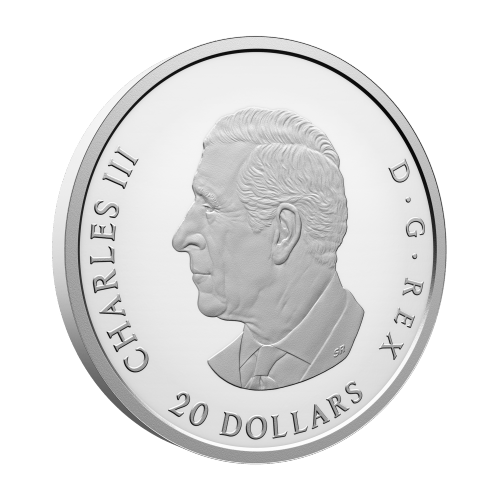
The reverse design by Canadian artist Tony Bianco presents a view of the Library of Parliament, located at the rear of the Centre Block building on Parliament Hill in Ottawa, Ontario. The historic octagonal stone building is highlighted by Ultra High Relief (UHR), which draws attention to its ornate High Victorian Gothic Revival architectural style. Selective colour also adds a profusion of fall colours to the scene, highlighting both the tree-covered bluff that rises from the Ottawa River and the maple leaves (above) that frame the view. Above the scroll banner, an open book displays the dates '1876' and '2026,' commemorating the Library’s 150th anniversary. The obverse features the effigy of His Majesty King Charles III by Canadian artist Steven Rosati.
ABOUT THE ROYAL CANADIAN MINT
The Royal Canadian Mint is known as one of the most reputable mints in the world. The Ottawa Branch of the Royal Mint opened in 1908 and was renamed The Royal Canadian Mint in 1931 when control was transferred to the Canadian government. Their high standards for excellence and quality allowed them to be the first refinery to manufacture 9999 fine gold bullion coins in 1982, as well as the first to reach 99999 fine gold purity in 1998.